|
1
|
- For: ASQ
- Larry LaBruyere, /
- larry.labruyere@trw.com
- July 10, 2002
|
|
2
|
- Audience will understand:
- why the FAA integrated process improvement models (Part 1)
- the content and structure of the FAA-iCMM, version 2.0 (Part 2)
- next Steps (Part 3)
|
|
3
|
- Audience understands:
- why process improvement is important
- what CMMs are, why they exist, and how to apply them
|
|
4
|
- Levels: CMMs identify levels that
guide process improvement - an improvement path
- Capability levels are groups of practices that work together to enhance
the capability of any process
- Maturity levels are groups of processes that are staged or placed
together to guide what might be improved first or next
- There are 6 capability levels (0 through 5) described next
- (Maturity levels are described later)
|
|
5
|
- Capability Level 0 – Incomplete
- An incomplete process is either not performed, or only partially
performed
- Capability Level 1 – Performed
- A performed process is being carried out, resulting in products and
services being provided to a customer.
- Products and services are generally adequate, but quality and
efficiency may vary depending on individual knowledge and effort.
- Processes may be ad hoc or occasionally chaotic, but are performed when
required.
- Capability to perform is not generally transferable.
|
|
6
|
- Capability Level 2 – Managed: Planned and Tracked
- A managed (planned and tracked) process is a performed (CL1) process
that is also managed, and carried out according to a documented plan
and process description.
- The plan identifies specific objectives for the process, such as
customer satisfaction, cost, schedule, or quality objectives.
- There are adequate resources, skilled practitioners, clear
responsibilities, controlled work products, performance measured
against the plan, and corrective actions taken including improving the
process being performed.
|
|
7
|
- Capability Level 3 – Defined
- A defined process is a managed, planned and tracked (CL2) process that
is tailored from the organization’s set of standard processes.
- The standard processes are established to meet business objectives and
are based on the organization’s knowledge and experiences.
- Measures and process improvement information are stored in an
organizational repository so that process knowledge is shared across
the organization.
- The standard processes and defined processes are improved and deployed
across the organization.
|
|
8
|
- Capability Level 4 - Quantitatively Managed
- A quantitatively managed process is a defined (CL3) process that is
controlled using quantitative techniques.
- Very specific objectives, measures, and processes are selected for
quantitative management.
- The capability of the process (range of expected results) is understood
statistically; special causes of variation are eliminated; performance
is stabilized within defined control limits.
- Actual, achievable business performance levels are understood.
|
|
9
|
- Capability Level 5 – Optimizing
- An optimizing process is a quantitatively managed (CL4) process that is
changed and adapted to meet relevant current and projected business
objectives.
- Changes are introduced to the specific processes that are under
statistical control to attempt to shift performance levels to meet
ever-stretching target levels set by the organization.
- Changes are through
- removing common causes of variation, or
- introducing new technology
|
|
10
|
- Background
- Requirements
- Integrating beyond CMMs
|
|
11
|
- Prior to 1997,
- FAA pursued, separately, improvement of software engineering, systems
engineering, and software acquisition processes
- Three single-discipline CMMs were being used
- in an isolated, uncoordinated way, with limited success
- with some exceptions, our processes were basically ad hoc and chaotic,
and … not integrated
- Need for more effective process improvement (aligned across disciplines
and life cycle phases, suited for integrated teams)
- Need for more efficient process improvement (separate CMMs
inconsistent, separate appraisals costly, training inefficient)
|
|
12
|
- In 1997,
- FAA developed the world’s first major integrated CMM, the FAA-iCMM,
v1.0
- faithfully and robustly combines all features of 3 CMMs (SA-CMM,
SE-CMM, SW-CMM)
- contains acquisition, engineering, management processes
- includes an appraisal method
- Version 1.0 released and service-marked in November 1997, and has been
in use since June 97
- Version 1.0 successfully deployed across much of the agency
|
|
13
|
- Based on success and experience with iCMM v1.0, stakeholders proposed
changes and enhancements
- Requirements for iCMM version 2.0:
- incorporate lessons learned from use of v1.0
- retain currency with evolving models and standards
- extend improvement guidance across additional business and technical
activities
- integrate additional improvement models and approaches
- 7 additional sources beyond original 3 CMMs
- Publication:
- iCMM v2.0 approval and publication – September 2001
- Mapping Table Supplement – October 2001
|
|
14
|
- Major sources integrated into iCMM v2.0:
- ISO 9001:2000 Quality Management Systems
- EIA/IS 731 Systems Engineering Capability
- Malcolm Baldrige National Quality Award/President’s Quality Award
Criteria*
- CMM Integrated: CMMI-SE/SW/IPPD and CMMI-SE/SW/A
- ISO/IEC TR 15504* Software
process assessment
- ISO/IEC 12207 Software life cycle processes
- ISO/IEC CD 15288* System Life Cycle Processes
- iCMM v1.0, containing SW-CMM, SA-CMM, and SE-CMM
- (* selected aspects of human resource management not in v2.0 scope)
|
|
15
|
- Architecture (how the model is structured)
- Process Dimension (what we do)
- Capability Dimension (how well we do it)
- Staging and Maturity Levels (what to focus on next)
- Appraisal (knowing where we are)
- Generic Attributes (measuring effectiveness)
|
|
16
|
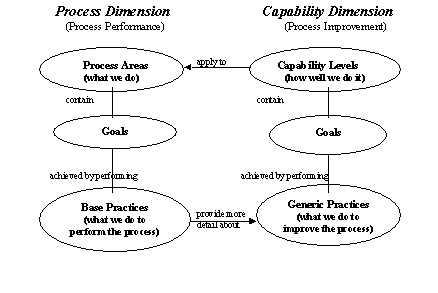
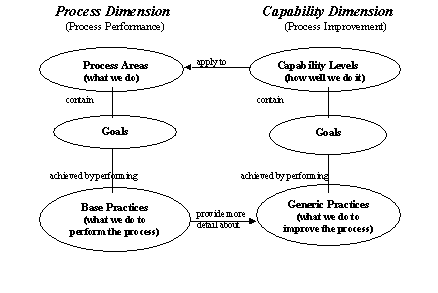
- FAA-iCMM is structured to provide flexible guidance for pursuing process
improvement.
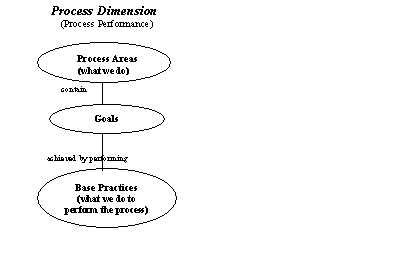
- Process dimension (what we do)
- focuses on process performance and provides best practice guidance
specific to performing management, life cycle, and support processes (including
process improvement processes)
- process areas group together base practices related to achieving goals
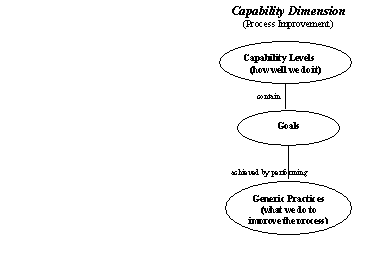
- Capability dimension (how well we do it)
- focuses on process improvement and provides best practice that is
generic and applies to improving any process
- capability levels group together generic practices related to achieving
goals
|
|
17
|
|
|
18
|
- Continuous representation
- process and capability dimensions enable an organization to choose any
processes, in any order, according to business objectives, and improve
them continuously, to any capability level.
- Staging (ordering of process areas or practices)
- iCMM generic practices are staged into capability levels.
- iCMM process areas are staged or grouped into maturity levels to provide
guidance regarding what to focus on next, if needed.
- iCMM architecture is called the“continuous with staging” representation
|
|
19
|
|
|
20
|
|
|
21
|
|
|
22
|
- Capability levels
- indicate increasing levels of ability to perform, control and improve
processes
- provide a path to improve the ability of a process to achieve required
goals (i.e., to improve process capability)
- each level represents a major enhancement in process capability
- Generic practices (GPs)
- relate to overall process management and institutionalization
- are staged and organized by capability level
- are additive and build on each other
- e.g. none of them “go away” as capability level increases
|
|
23
|
|
|
24
|
|
|
25
|
- The choice of improvement areas is always based on business objectives
- However, iCMM groups PAs and CLs into maturity levels to provide:
- Guidance for ordering or prioritizing PAs, if needed
- in general, PAs at one maturity level provide a foundation for PAs in a
level that follows
- Summarized maturity “levels”, if needed
- for benchmarking with other models that define maturity levels (i.e.,
SA-CMM and CMMI)
- for summarizing a stage of process maturity
|
|
26
|
- There are 9 PAs staged at maturity level 2
- Management: Project Management; Supplier Agreement Management
- Life Cycle: Requirements; Evaluation; Deployment, Transition, and
Disposal
- Support: Outsourcing; Quality Assurance and Management; Configuration
Management; Measurement and Analysis
- Maturity level 2 means these 9 process areas have satisfied capability
levels 1 and 2 according to an FAA-iCMM appraisal
- they may be higher than CL2
- PAs that are “not applicable” do not detract from achieving ML2
|
|
27
|
- There are 11 process areas staged at maturity level 3
- Management: Integrated Enterprise Management; Risk Management;
Integrated Teaming
- Life Cycle: Needs; Design; Design Implementation; Integration
- Support: Alternatives Analysis; Process Definition; Process
Improvement; Training
- Maturity Level 3 means: all level 2 process areas plus the above 11
process areas have satisfied capability levels 1, 2, and 3 according to
an FAA-iCMM appraisal
- again, PAs that are not applicable do not detract from achieving ML3
|
|
28
|
- Maturity Level 4:
- no PAs are staged at this level
- to achieve ML4, ML3 must be achieved, plus capability level 4 on
selected PAs
- Maturity Level 5:
- PA 23 Innovation is staged at ML5
- to achieve ML5, all staged PAs must achieve capability level 3, and capability
level 5 must be achieved on selected PAs
- Two iCMM PAs are not staged: PA 10 Operation and Support; PA 17
Information Management
- their content is not included in any CMM benchmarks
|
|
29
|
- An appraisal is a comparison of an organization’s operations to a model
or standard
- Appraisal purposes:
- Initiate - focus, motivate,
direct, and/or launch improvement within an organization
- Baseline - determine current status compared to a reference model,
baseline or rebaseline
- Track - track process improvement progress, confirm status
- Direct - identify strengths and
weaknesses and areas needing improvement
- basis for action planning
- An appraisal may also identify/develop process assets
|
|
30
|
- Appraisal types included in FAM:
- Full internal appraisal (formal, robust, method - comes up with
official ratings)
- External appraisal (for external evaluation of FAA processes)
- Facilitated discussion (derives description of a compliant, improved
process and an implementation plan)
- Document-intensive (examines process documents and work products)
- Questionnaire-based (based on managers’ and practitioners’ perceptions)
- Interview-based (uncovers major issues)
|
|
31
|
- Generic Attributes (GAs) are:
- a new feature introduced in iCMM version 2
- a way of measuring process performance results
- There are 2 GAs:
- Usefulness: the extent to which work products or services provide
needed benefits in actual use
- Cost Effectiveness: the extent to which benefits received are worth the
resources invested (determined by comparing usefulness to resource
efficiency)
- A new appraisal variation to determine Generic Attributes will be
piloted and described in next version of the FAM
|
|
32
|
- This concludes Part 3: The FAA-iCMM
- Any questions on
- Architecture (continuous with staging)
- Process Dimension (what we do)
- Capability Dimension (how well we do it)
- Staging and Maturity Levels (what to focus on next)
- Appraisal (knowing where we are)
- Generic Attributes (measuring process effectiveness)
|
|
33
|
- Transitioning to iCMM version 2.0
- guidelines and FAQ sheets are available
- appraisals using iCMM v2.0 have already been performed, and more are
scheduled
- Extension:
- next areas for inclusion in iCMM are safety and security (approved by CCB; will be pursued in
collaboration with other agencies)
|
|
34
|
- Other organizations
- the iCMM is not specific to the FAA
- other organizations are using it
- outside organizations briefed
- FAA will use iCMM in contract monitoring
|
|
35
|
- Any questions on
- Part 1: Why the FAA integrated process improvement models
- Part 2: Content and structure of the FAA-iCMM, version 2.0
- Part 3: Next Steps
|
|
36
|
- Dr. Linda Ibrahim
- Chief Engineer for Process Improvement
- Process Engineering Division (AIO-200)
- Tel: 202-267-7443 Fax:
202-267-5069
- email: linda.ibrahim@faa.gov
- The FAA-iCMM®, its Appraisal Method, and other related
documents are available at:
- www.faa.gov/aio and www.faa.gov/ipg
- ® Capability Maturity Model and CMM are registered with the U.S. Patent
and Trademark Office
|

 Notes
Notes